

In airports, every second is strategic. When thousands of passengers move simultaneously between check-in, gates, security checkpoints and boarding areas, visual information becomes an operational asset of critical importance. Today, Digital Signage in airport environments is no longer optional but a mission-critical system that must operate with precision, withstand extreme environmental conditions and integrate seamlessly with complex IT infrastructures, leaving no room for error.
In the transportation sector, the use of purpose-built industrial displays is essential to ensure perfect 24/7 readability, ease of maintenance, operational safety and full compatibility with centralized management platforms.
With over 30 years of experience in developing professional Digital Signage solutions for the transportation industry, Fida is a strategic partner for airports, system integrators and contractors seeking quality, reliability and customization. In this article, we take you inside the principles, technologies and design choices that make Digital Signage an invisible yet essential pillar of modern air mobility.

Airport Digital Signage: functions and strategic objectives
Airport Digital Signage is a set of hardware technologies – such as digital totems and video walls – and software solutions that enable the distribution of real-time dynamic content on professional displays installed at key points throughout the terminal.
These are not simple display tools but fully integrated components within the operational, security and customer experience processes of airport infrastructure.
Let’s take a closer look at the main functions and strategic objectives of Digital Signage in an airport environment.
- Supporting operational management with real-time updates
Information related to schedules, gates, boarding, delays and cancellations must be clearly visible and updated in real time. In this context, digital displays must guarantee service continuity, excellent readability and seamless synchronization with the airport’s central systems. Hardware reliability is critical: a single failure can cause large-scale disruptions, with operational, reputational and economic consequences. - Facilitating passenger orientation through dynamic, multilingual wayfinding
Smooth passenger flow is a top priority in high-traffic environments. Digital Signage enables the creation of dynamic routes that can be updated according to operational conditions, with multilingual content and optimized visual design. Displays must offer versatile formats, modular mounting and installation at height or suspended from ceilings, as well as immediate readability from a distance and wide viewing angles – key design elements that Fida integrates into its wayfinding solutions. - Enhancing emergency communication
In the event of evacuation, fire, blackout or crisis situations, displays become essential tools for delivering alert messages, escape route instructions and real-time updates. Hardware must be designed to ensure structural robustness, power redundancy, compatibility with emergency management systems and clear visibility even in critical environmental conditions such as smoke, partial darkness or widespread panic. - Generating advertising revenue with adaptive content
Digital spaces within airports represent one of the most profitable platforms for out-of-home advertising. Displays must support dynamic advertising loops, geolocated or targeted content based on time slots, seasonality or flight type. - Improving the passenger experience
Clear, visible and well-distributed information helps reduce anxiety and the perceived waiting time. Digital Signage, when integrated with infotainment systems, ambient content and commercial services, can turn waiting time into an engagement opportunity. For this reason, displays must offer high resolution, perfect visibility from all angles and a design that integrates seamlessly with terminal architecture.
Essential technical features for airport Digital Signage
A Digital Signage system intended for high-traffic and continuous-operation environments such as airports requires extremely high construction standards. Fida solutions are designed to meet the following requirements:
High-brightness displays and extended contrast
In airport environments, content readability is a functional requirement. Displays installed in areas exposed to direct sunlight – such as glass atriums, entrance halls or gates with external exposure – must ensure brightness levels of up to 3,000 nits, with contrast values optimized for high-brightness environments. Fida solutions integrate industrial LED and LCD panels with IPS technology, ensuring perfect visibility even at viewing angles greater than 178°. Thanks to integrated ambient sensors, brightness automatically adapts in real time to surrounding light conditions, improving energy efficiency without compromising visibility.
Mechanical robustness and environmental resistance
Hardware infrastructure for airport Digital Signage must withstand daily wear and external agents. Fida solutions are built with steel and aluminium structures treated with anti-corrosion processes, making them suitable for critical indoor environments and outdoor installations. IP55 and IP65 certifications confirm their suitability for dusty, humid or rain-exposed environments. The front glass, tempered and anti-glare, provides effective anti-vandal protection while enhancing readability in all lighting conditions.
24/7/365 operational continuity and easy maintenance
Continuous reliability is an essential requirement for any digital infrastructure in airports. For this reason, Fida solutions are designed to ensure uninterrupted operation 24 hours a day, 365 days a year and feature front access for quick and easy cleaning and maintenance operations.
Digital Signage for airports: applications
Fida’s design approach starts with a functional analysis of airport spaces to identify the most effective solutions based on passenger flow, natural light, viewing distance and content type. Key applications include:
Interactive touch totems for wayfinding and self check-in
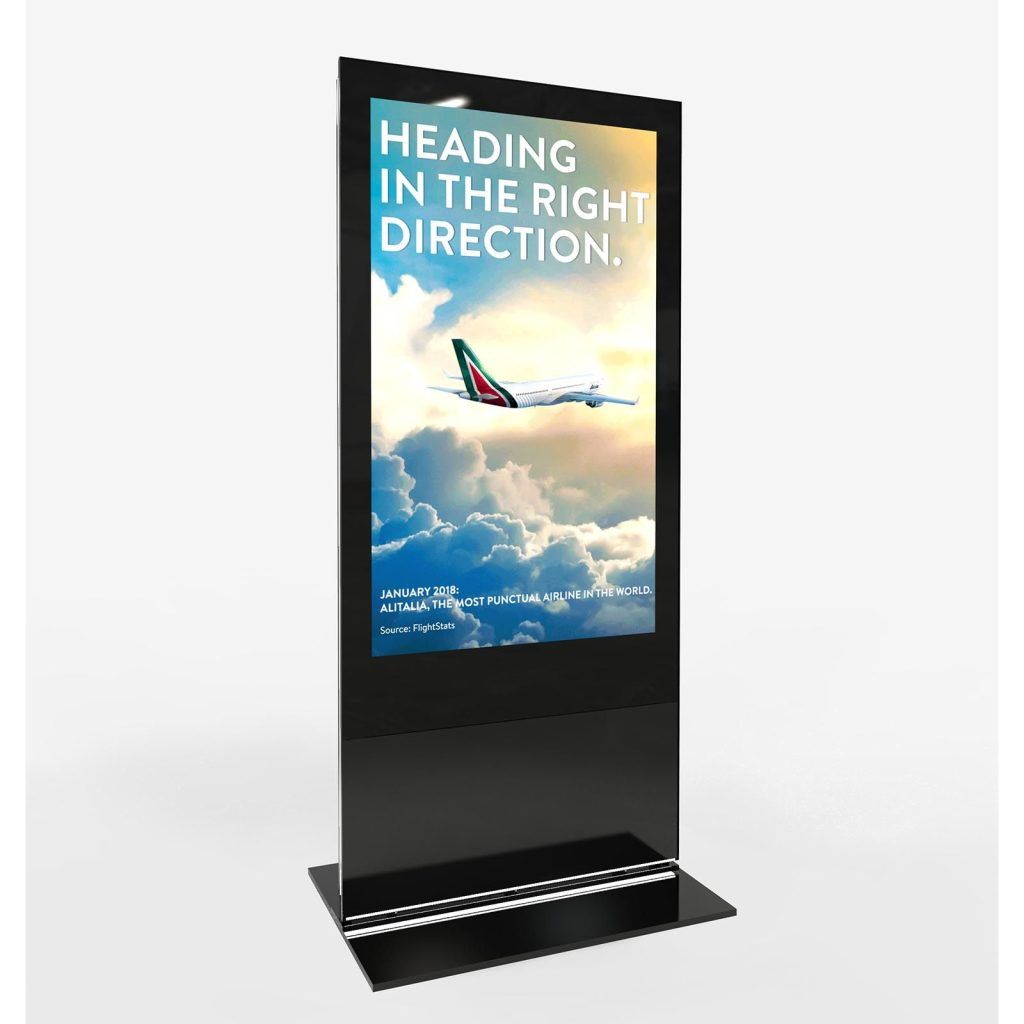
EKO- Semi-Outdoor Digital Totem
Enhances wayfinding and self check-in experiences in airports, offering high-visibility touch interactions and continuous operation even in semi-outdoor areas exposed to dust, heavy traffic or challenging environmental conditions.

TWI – Interactive Wayfinding Kiosk
Provides passengers with an intuitive, fast and accurate orientation experience through smooth 3D map visualization and service information, delivered via a robust, scratch-resistant touch interface ideal for indoor airport terminals.


Optimizes the airport check-in process with secure and efficient self-service functions, integrating ticket printing, document scanning and electronic payments in a kiosk designed to handle large passenger flows.


Displays in departure and arrival areas
KFI – Outdoor LED Strip Display
An ideal solution for clearly and instantly displaying arrival and departure information in airport areas, ensuring maximum brightness, low energy consumption and continuous reliability thanks to latest-generation SMD LEDs and an advanced remote diagnostics system.


SMO – Semi-Outdoor LCD Monitor
Ensures airport communications remain visible and reliable in semi-outdoor departure and arrival areas, thanks to its industrial anti-corrosion structure, complete protection against water and dust and 24/7 operation even in extreme environmental conditions.


Digital Signage for duty-free areas and food courts
TSK – Self-Service Payment Kiosk
Optimizes the shopping experience in duty-free areas and food courts by offering a fast, intuitive and customizable self-service payment system, ideal for reducing queues and increasing customer turnover..


TKI – Multifunction Interactive Kiosk
Makes shopping paths in duty-free areas and food courts more engaging and informative, allowing passengers to browse digital catalogs, offers, interactive menus and multimedia content, while also serving as a queue-management terminal or entry-level self-ordering solution.


EKO – Semi-Outdoor Digital Totem
Enhances duty-free spaces and food courts with high-visibility dynamic content, ideal for promotions, commercial wayfinding and multilingual communications, while ensuring continuous reliability in semi-outdoor areas with heavy passenger traffic.
Monitors in boarding gates and lounge areas with mixed content – information and advertising
Ensures clear and reliable communication in boarding gates and airport lounges, offering high-resistance displays and continuous operation ideal for combining operational information and advertising content with maximum visibility and service continuity.
EKO Semi-Outdoor Digital Totem
Enriches gates and lounges with high-impact informational and promotional content, ensuring excellent readability even in bright areas and 24/7 operation, ideal for boarding announcements, dynamic communications and real-time advertising campaigns.
Outdoor totems for pre-entry communications – parking areas and bus-shuttle terminals
EKS – High-Brightness Outdoor Digital Totem
The ideal solution for pre-entry communications in parking areas and bus-shuttle terminals, thanks to brightness levels of up to 4,000 nits that ensure full readability even under direct sunlight, a robust IK10 anti-vandal structure and reliable operation in all environmental conditions.


Enhances external parking and terminal areas with high-impact advertising and informational content, delivering vibrant colors even in direct sunlight, high resistance to weather conditions and an elegant design that integrates harmoniously into public spaces.


Improves access experiences in parking areas and bus-shuttle terminals by displaying real-time schedules, directions and animations with brightness levels of up to 4,000 nits and continuous 24/7 operation, customizable with sensors and advanced devices to meet any operational requirement.


Contact us to receive more information.