

Digital Signage is evolving from a simple content display tool into an integrated component of broader digital ecosystems. In the most advanced projects, professional displays can communicate with software, information platforms and connected devices, receiving data and updating messages according to the context.
The convergence of Digital Signage, Artificial Intelligence and the Internet of Things opens up particularly interesting opportunities for public transport, Passenger Information and Smart Cities. Arrivals, departures, delays, alerts, environmental conditions and operational information can be distributed more promptly and consistently.
However, this evolution requires a reliable hardware foundation.
Digital Signage solutions designed for professional applications must ensure readability, durability, operational continuity and seamless integration with external systems.
What Is Smart Digital Signage?
Smart Digital Signage is a system in which displays, software and information sources communicate with one another. Content is not simply scheduled in advance but can be updated based on operational data, environmental conditions or external events.
In a traditional system, images, videos and messages are uploaded to a Content Management System, scheduled and then displayed on screens. This model remains effective when content is predictable and does not require frequent updates.
A connected system, on the other hand, can receive data from:
- passenger information platforms;
- corporate databases;
- emergency management systems;
- environmental sensors;
- weather services;
- device monitoring and control systems;
- third-party APIs and software.
The display thus becomes a node within a digital infrastructure. It can show real-time information and, when technically equipped to do so, report its operational status to the central system.
Automation and Artificial Intelligence
Not all dynamic content relies on AI. A display that adjusts its brightness at a scheduled time or shows an alert after receiving specific data can operate through automated rules.
Artificial Intelligence more specifically refers to systems that use models capable of analysing data, detecting anomalies, making predictions, classifying information or generating content.
This distinction is important: rule-based automation is generally easier to control, whereas AI requires particular attention to data quality, the reliability of its outputs and human oversight.
| Aspect | Traditional Digital Signage | IoT-Connected Digital Signage | AI-Supported Digital Signage |
| Updates | Manual or scheduled | Triggered by data and platforms | Adapted through analysis or predictions |
| Information sources | Content uploaded to the CMS | APIs, sensors and operational systems | Historical and real-time data |
| Monitoring | Periodic checks | Remote parameter monitoring | Potential early detection of anomalies |
| Adaptation | Predefined schedules | Context-based rules | Models capable of recognising patterns |
| Key considerations | Display quality | Connectivity and interoperability | Data quality and human oversight |
How Can Artificial Intelligence Transform Digital Signage?
AI could help operators manage complex Digital Signage networks by selecting the most relevant information, analysing data and identifying potential anomalies. Its main role would be to support decision-making.
One potential application is the adaptation of content based on time, location, environmental conditions and operational circumstances.
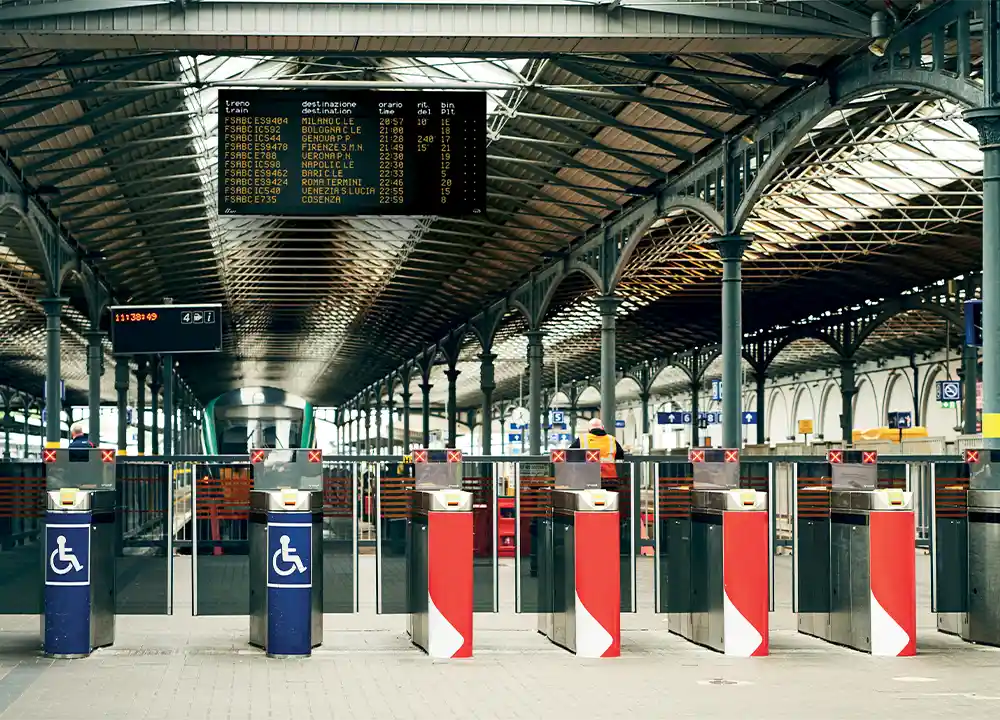
At a railway station, for example, a service disruption could trigger the priority display of an alert in the affected areas. At an urban bus shelter, the system could prioritise route changes, relevant weather conditions or public service announcements.
AI could also analyse historical data to understand:
- when specific issues occur most frequently;
- which areas require more information;
- which messages need to be translated;
- when the need for wayfinding information increases;
- which communications should take priority.
However, the results would depend on the quality and completeness of the data. Incorrect or outdated information can compromise the performance of even the most advanced system.
Predictive Maintenance and Anomaly Detection
Parameters such as temperature, power consumption, brightness and error frequency could be analysed to identify unusual behaviour.
Predictive display maintenance would aim to detect signs of potential deterioration before a complete failure occurs, allowing operators to plan maintenance activities in advance.
However, this capability requires suitable sensors, continuous data collection and sufficiently reliable models. It should therefore not be regarded as an automatic feature of every connected display.
Generative AI could also support content summarisation and translation. In transport and emergency communications, however, automatically generated messages should always be reviewed: an error concerning a time, destination or procedure could undermine the clarity of the information.
What Is the Role of IoT in Digital Signage?
The Internet of Things enables displays, sensors and platforms to exchange information. In Digital Signage, it can support remote monitoring, real-time updates and integration with external systems.
IoT does not simply mean having an Internet connection. It involves a system in which devices, data and platforms communicate with one another.
A connected network could collect information on:
- device power status;
- device temperature;
- brightness levels;
- energy consumption;
- connection status;
- correct content display;
- component malfunctions;
- environmental conditions at the installation site.
The data can be transmitted to a central platform, allowing operators to monitor and control numerous displays installed across different stations, stops or cities.
Remote Display Management
Remote management makes it possible to check the status of devices without waiting for an on-site inspection. When a problem occurs, the system can report the anomaly and help distinguish between a connection issue and a display malfunction.
This type of network requires reliable connections, secure device identification, controlled updates and proper access management.
ENISA highlights the importance of addressing IoT security throughout the entire device lifecycle, from design to maintenance.
How Could Passenger Information Systems Evolve?
In the transport sector, AI and IoT could make passenger information faster, better coordinated and more consistent. Displays would remain the visible interface of a system connected to passenger information platforms and smart infrastructure.
Passenger Information Systems provide essential information such as:
- arrivals and departures;
- delays and cancellations;
- platform or stop changes;
- route changes;
- wayfinding information;
- safety alerts;
- multilingual communications.
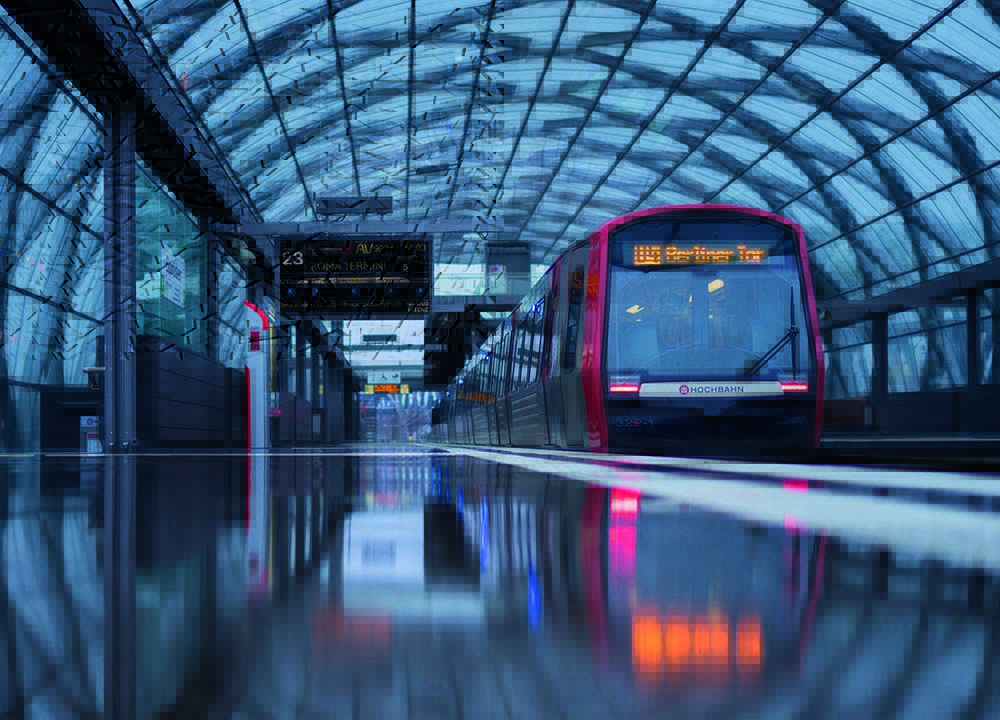
Transportation solutions include displays and systems designed for railway stations, bus stops, metro stations and transport hubs, where readability, durability and operational continuity are essential requirements.
In the future, integration between displays and operational systems could enable updates to be distributed automatically across multiple information points. A platform change, for example, could be communicated through displays at station entrances, in waiting areas and along internal routes.
Artificial Intelligence could help prioritise messages, suggest alternative routes, translate alerts or identify areas where additional information is needed.
What Opportunities Are There for Smart Cities and Public Spaces?
In Smart Cities, connected displays can become access points for information about mobility, public services, events and environmental conditions.
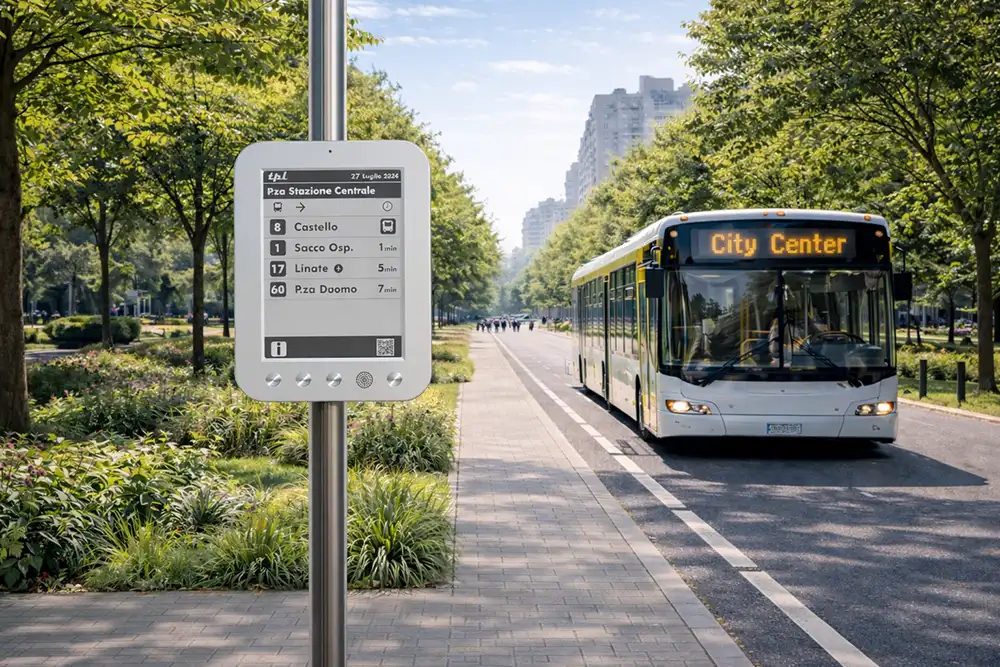
An urban bus shelter or outdoor kiosk could provide information on:
- public transport waiting times;
- route changes;
- maps and directions;
- local events;
- municipal services;
- alerts and emergencies;
- weather and environmental conditions.
E-paper displays are particularly useful when low energy consumption, readability in direct sunlight and the display of content that does not change continuously are required. Interactive bus shelter displays and outdoor kiosks, on the other hand, can make it easier to access maps, routes and services.
What Limitations Should Be Considered?
A future-ready system is not one that uses the greatest number of technologies, but one that remains reliable, secure and upgradable over time.
The main aspects to consider include:
- data quality and reliability;
- interoperability between hardware and software;
- connection continuity;
- cybersecurity;
- access management;
- device updates;
- data protection;
- management and maintenance costs;
- human oversight;
- infrastructure reliability.
A connected system must also account for what happens when the network is unavailable. The display could retain the last valid information, show safety content or use a locally stored schedule.
Security must cover the entire ecosystem: displays, platforms, software, networks and management systems.
The European regulatory framework for Artificial Intelligence adopts a risk-based approach and places particular emphasis on data quality, transparency, robustness, cybersecurity and human oversight. However, the applicable obligations depend on how each system operates and is classified, rather than simply on the use of AI in Digital Signage.
Future-oriented design should take into account:
- modularity;
- upgradability;
- hardware quality;
- resistance to environmental conditions;
- energy efficiency;
- integration capabilities;
- ease of maintenance;
- information accessibility;
- operational continuity.
A Reliable Foundation for Future Developments
The convergence of Digital Signage, AI and IoT creates new opportunities to make communication more timely, coordinated and reliable. Turning these possibilities into truly effective solutions, however, requires reliable data, secure integrations and a hardware infrastructure designed for the specific installation environment.
With over 30 years of experience in electronics and industrial mechanics, FIDA develops and manufactures professional displays and systems in Italy for Digital Signage, Passenger Information and Transportation Solutions, customising them to meet specific operational and environmental requirements.
Working with FIDA makes it possible to identify the most suitable hardware features and integration options for a digital communication or passenger information project, creating a reliable foundation for future developments.
FAQ – Frequently Asked Questions About Digital Signage, Artificial Intelligence and IoT
What is smart Digital Signage?
It is a visual communication system connected to external software, data and platforms. It can update information in real time and adapt content through automated rules or more advanced analysis.
Do all connected displays use Artificial Intelligence?
No. A display can update its content based on data and traditional automation. AI is used when the system analyses information, detects anomalies, makes predictions or generates content.
How can IoT improve display management?
It can enable the monitoring of temperature, brightness, energy consumption, connectivity and component status, transmitting this information to a central platform.
Can AI manage passenger information autonomously?
It can support the translation, selection and prioritisation of alerts. However, operational and emergency communications require reliable sources, clearly defined procedures and human oversight.
How can a Digital Signage system be prepared for future developments?
Through professional, upgradable and integrable hardware, combined with a design approach that takes security, connectivity, maintenance, energy efficiency and operational continuity into account.